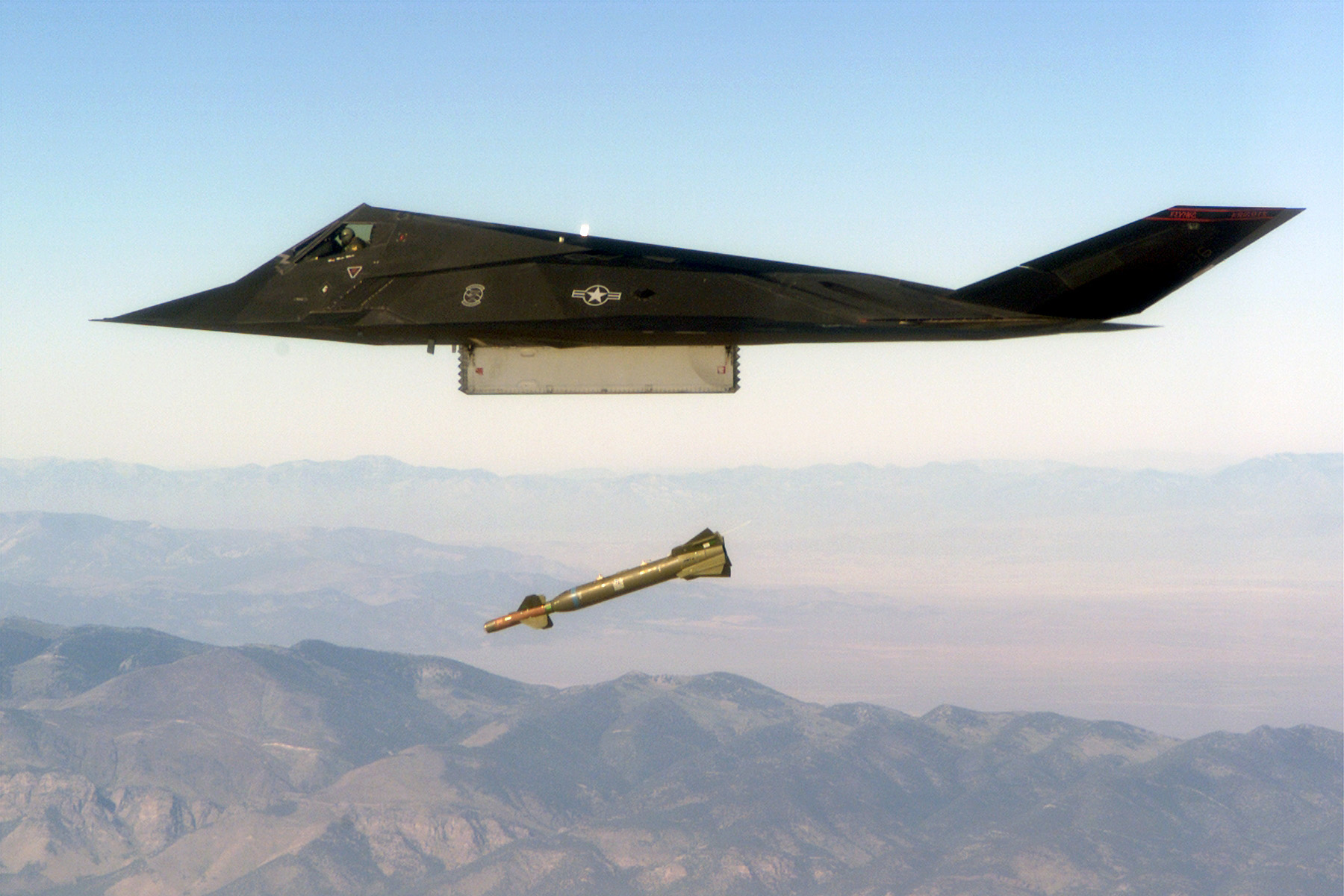


In April 1976, DARPA awarded Lockheed’s Skunk Works a contract for the Have Blue stealth demonstrator to prove whether an aircraft with an extremely small radar cross-section was possible. The faceted design drew on Soviet physicist Pyotr Ufimtsev’s equations for radar reflection from angular surfaces. Lockheed mathematicians Bill Schroeder and Denys Overholser ran those calculations through a program called Echo. Flat panels were chosen because computers of the era could not yet model curved-surface stealth.
Have Blue first flew in December 1977. The follow-on F-117 contract was awarded in November 1978. The first F-117 flew on June 18, 1981, with Lockheed test pilot Hal Farley at the controls. The program stayed classified for more than seven years. It reached initial operational capability in October 1983 and was not publicly acknowledged until November 1988.
Despite the fighter designation, the F-117 carried no air-to-air weapons and no radar. It was a single-seat night precision-strike aircraft that used infrared targeting and pre-programmed coordinates against fixed targets. It first saw combat in the 1989 Panama invasion and became well known in the 1991 Gulf War, where it flew roughly 2 percent of coalition attack sorties yet struck about 40 percent of the strategic targets, including heavily defended sites over Baghdad.
Lockheed built 64 airframes: 59 production aircraft and 5 prototypes. The Air Force retired the type in April 2008 as the F-22 entered service.
Specifications
- Length: 65 ft 11 in (20.1 m)
- Wingspan: 43 ft 4 in (13.2 m)
- Height: 12 ft 5 in (3.8 m)
- Empty weight: 29,500 lb (13,380 kg)
- Max takeoff weight: 52,500 lb (23,800 kg)
- Engines: two General Electric F404-F1D2 non-afterburning turbofans, 10,600 lb thrust each
- Top speed: Mach 0.92 (617 mph / 993 km/h), high subsonic
- Range: unlimited with aerial refueling; unrefueled range typically cited between 650 and 930 nm depending on profile
- Service ceiling: 45,000 ft (13,716 m)
- Armament: up to 5,000 lb (2,268 kg) of guided munitions in two internal bays
- Crew: 1