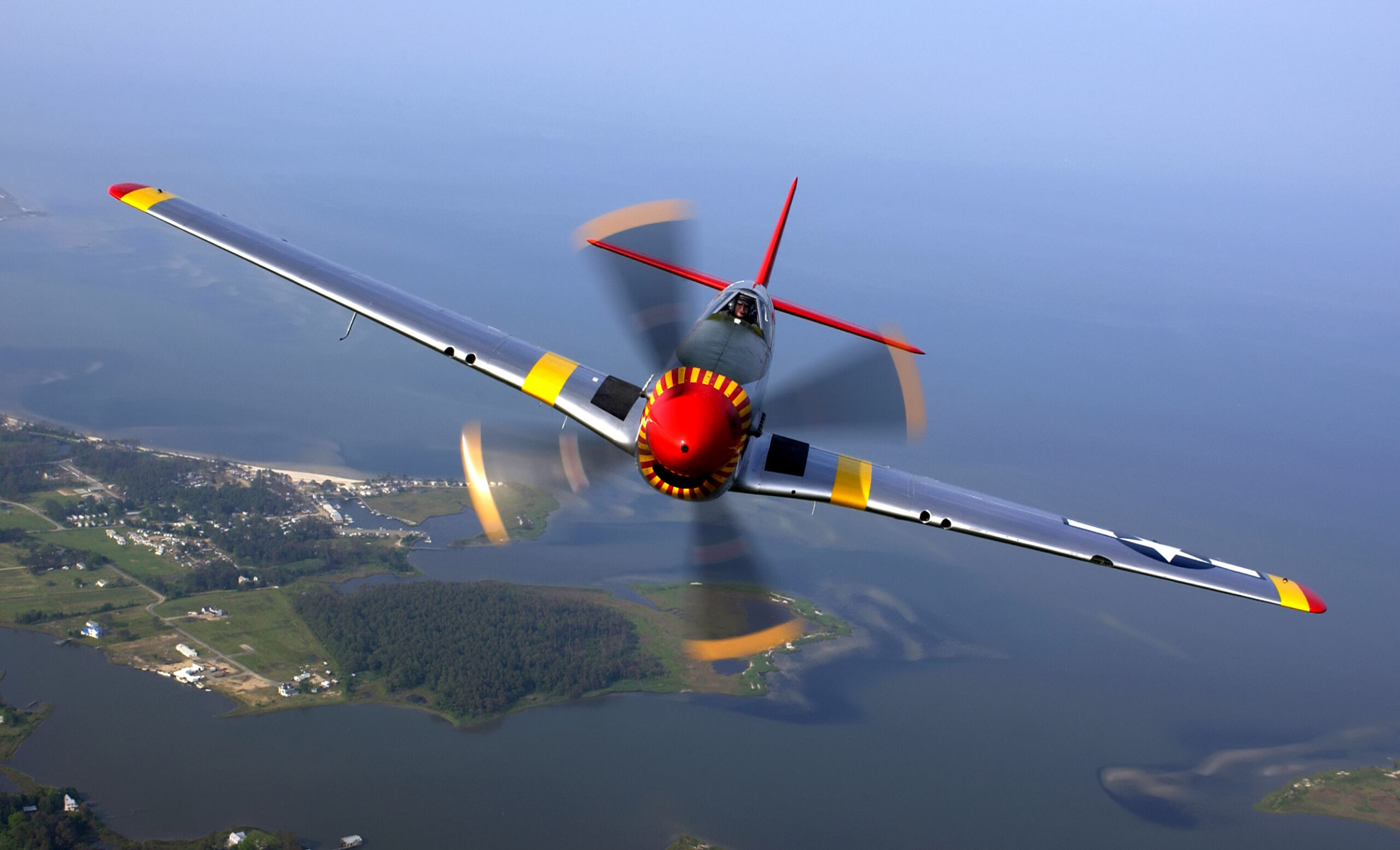


Originally designed in 1940 at the request of the British Purchasing Commission, the P-51 Mustang started out with an Allison engine that performed poorly at high altitude. The aircraft’s fortunes changed when engineers paired the airframe with the British Rolls-Royce Merlin engine, transforming it into one of the best fighters of World War II.
With drop tanks extending its range past 1,000 miles, the Mustang became the first fighter capable of escorting American heavy bombers deep into Germany and back, a role that P-47 Thunderbolts and P-38 Lightnings couldn’t fill on their own. Its arrival over Berlin in early 1944 caught German commanders off guard and marked a turning point in the air war over Europe, as Luftwaffe losses climbed sharply once bombers had fighter cover the whole way to target.
The Mustang went on to serve with dozens of air forces after the war and remained in frontline service with some countries into the 1980s.
Aircraft: North American P-51D Mustang
- Length: 32 ft 3 in (9.8 m)
- Wingspan: 37 ft (11.3 m)
- Height: 13 ft 8 in (4.2 m)
- Empty weight: 7,635 lb (3,463 kg)
- Engine: Packard V-1650-7 (license-built Rolls-Royce Merlin), 1,490 hp
- Top speed: 437 mph (703 km/h)
- Range: 1,650 mi (2,655 km) with external fuel
- Armament: six .50 caliber machine guns
- Service ceiling: 41,900 ft (12,770 m)