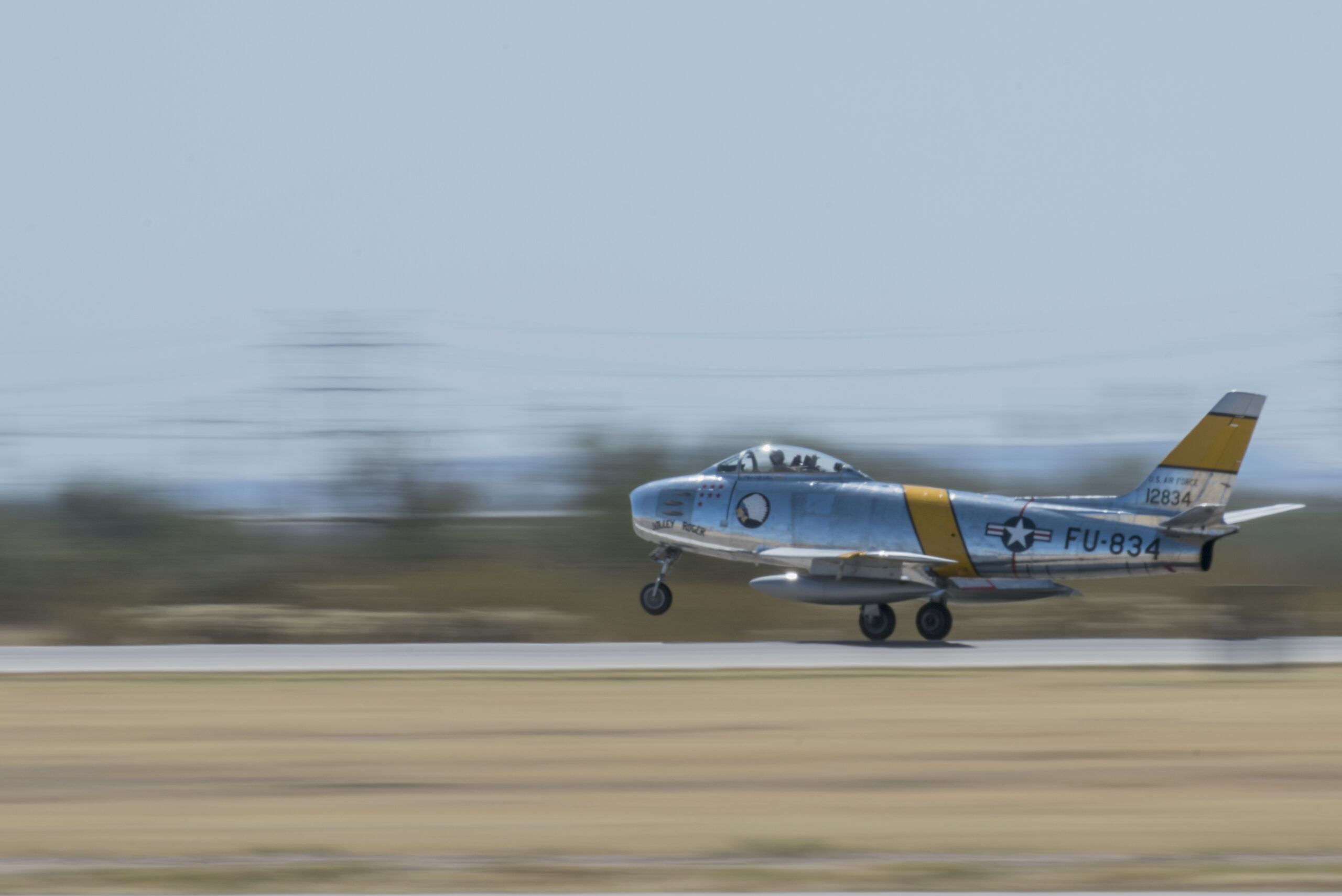


Developed in the years just after World War II, the F-86 Sabre owed its game-changing performance to captured German aerodynamics research. Engineers had originally designed it with straight wings, but data recovered from Messerschmitt’s wartime studies showed that a swept wing could delay the onset of compressibility problems at high speed, so North American reworked the design before it ever flew. The prototype first flew on October 1, 1947, with George Welch at the controls, and the production F-86A entered service in 1949.
The Sabre earned its reputation over Korea, where it was rushed in to counter the Soviet-built MiG-15, a fighter that had outclassed earlier American jets. Along the Yalu River, in an area pilots nicknamed “MiG Alley,” Sabre pilots claimed a lopsided kill ratio against MiG-15s, though the exact figures have been debated by historians since. An F-86A also set a world speed record of 670.9 mph in September 1948, just months after entering service.
The design remained in frontline U.S. service through the 1950s and continued flying with foreign air forces for decades afterward, with total production reaching nearly 10,000 aircraft across all variants and licensed builds.
Aircraft: North American F-86F Sabre
- Length: 37 ft 6 in (11.4 m)
- Wingspan: 37 ft 1 in (11.3 m)
- Height: 14 ft 8 in (4.5 m)
- Empty weight: approximately 11,125 lb (5,046 kg)
- Loaded weight: 13,791 lb (6,256 kg)
- Engine: one General Electric J47-GE-27 turbojet, 5,200 to 5,910 lb thrust
- Top speed: 685 mph (1,102 km/h)
- Cruising speed: 540 mph (869 km/h)
- Range: 1,200 mi (1,931 km)
- Combat ceiling: 49,000 ft (14,935 m)
- Armament: six .50 caliber machine guns, plus eight 5-inch rockets or up to 2,000 lb (907 kg) of bombs
- Crew: 1