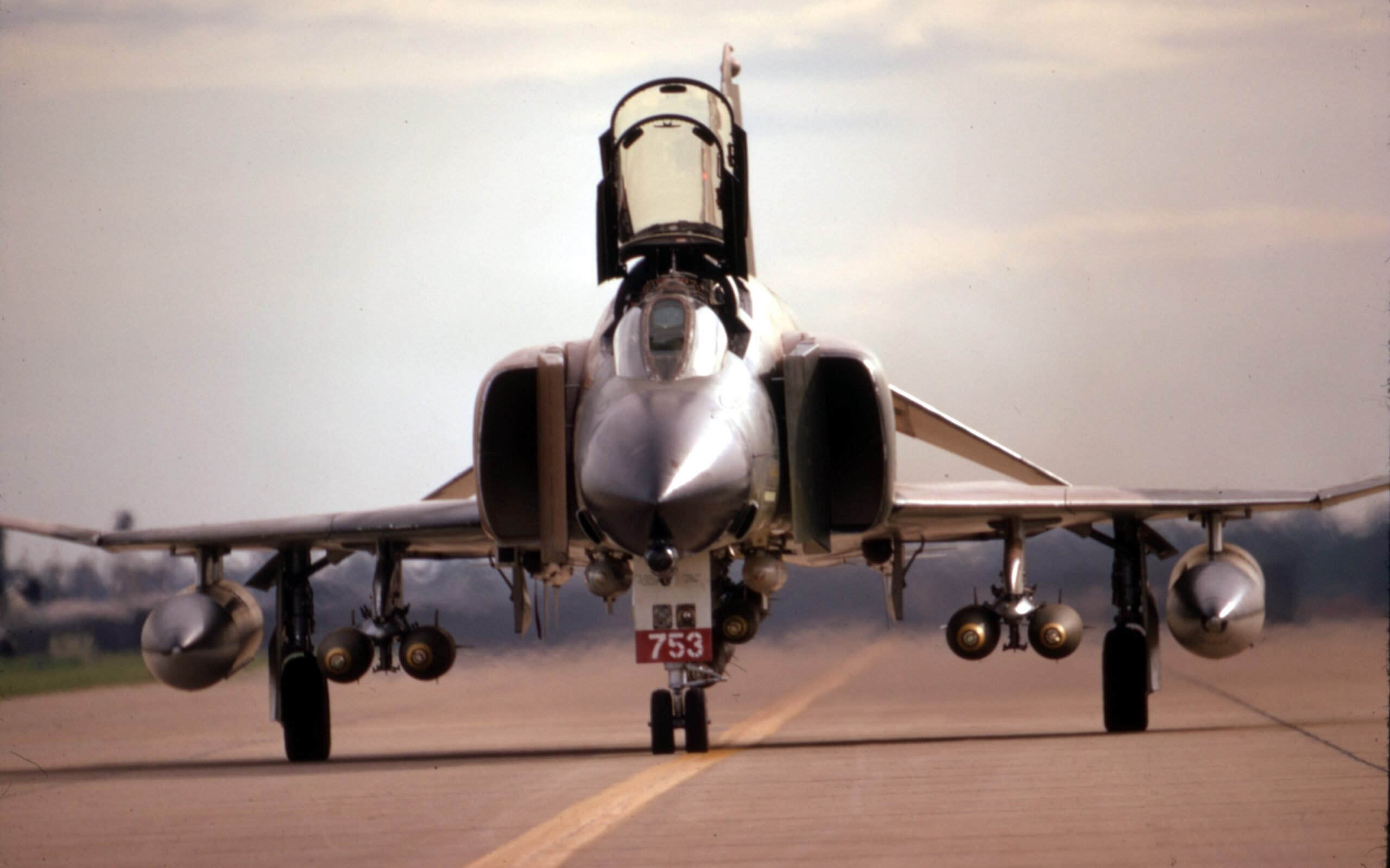


Originally designed in the late 1950s as a fleet defense interceptor for the U.S. Navy, the F-4 Phantom II went on to become one of the most widely used American combat aircraft of the Cold War, flown by the Navy, Air Force, and Marine Corps alike. It set numerous world speed and altitude records in its early years and was initially built without an internal gun, based on the assumption that missiles had made close-in dogfighting obsolete.
That assumption was tested hard over Vietnam, where Phantoms faced nimble MiG-17s and MiG-21s in visual-range combat. Early missile reliability problems forced pilots into turning fights the aircraft wasn’t originally optimized for, and the F-4E variant later added an internal 20mm cannon to address the gap. Despite the rocky start, the Phantom became the backbone of American air power through the 1960s and 1970s, flying air superiority, strike, and reconnaissance missions.
The F-4 remained in U.S. service into the early 1990s and continued flying with foreign air forces for decades afterward, with a handful of countries operating them into the 2020s.
Aircraft: McDonnell Douglas F-4E Phantom II
- Length: 63 ft (19.2 m)
- Wingspan: 38 ft 5 in (11.7 m)
- Height: 16 ft 5 in (5.0 m)
- Empty weight: 30,328 lb (13,757 kg)
- Engines: two General Electric J79-GE-17A turbojets, 17,900 lb thrust each with afterburner
- Top speed: Mach 2.23 (1,470 mph / 2,370 km/h)
- Range: approximately 900 mi (1,450 km) combat radius with external tanks
- Armament: one 20mm M61A1 Vulcan cannon, plus up to 16,000 lb (7,257 kg) of missiles and bombs
- Crew: 2