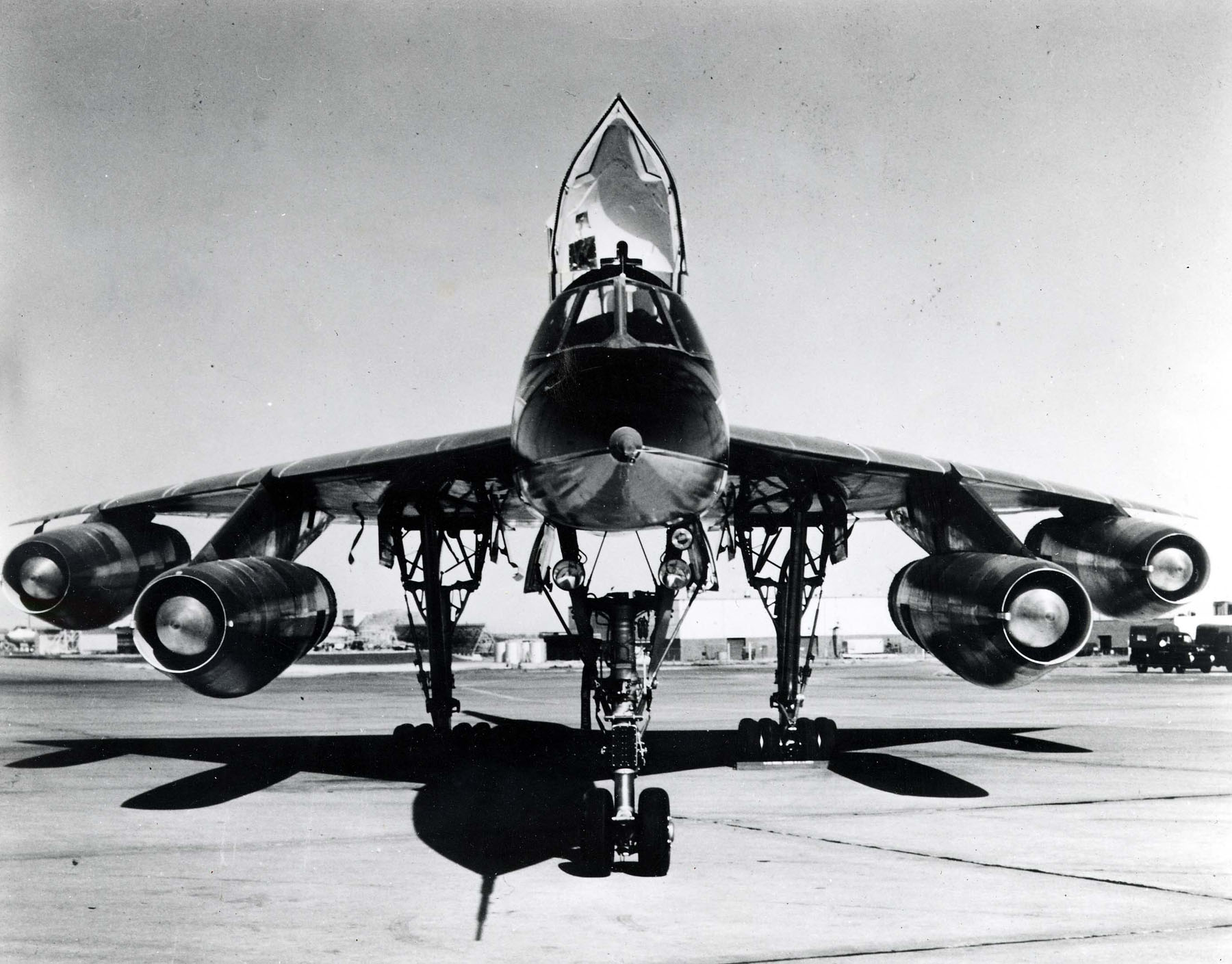
Convair built the B-58 to do what no bomber had done: hold Mach 2 in level flight and put a nuclear weapon on a distant target before fighters or missiles could catch it. The prototype first flew at Fort Worth on 11 November 1956 and went supersonic before the year was out. Strategic Air Command declared it operational on 15 March 1960.
The airframe was an area-ruled wasp-waist fuselage under a thin delta wing. Four General Electric J79 afterburning turbojets hung in separate pods. A three-man crew sat in tandem: pilot, navigator-bombardier, and defensive systems operator. Each later received an encapsulated ejection seat after early escape gear proved inadequate. The main weapon was not in a conventional bomb bay. It rode in a large ventral pod, with later aircraft adding four underwing pylons for extra nuclear stores. A remotely aimed 20 mm tail gun covered the rear.
The Hustler set a string of speed and time-to-climb records, including New York to Paris in under three and a half hours. It was also expensive, short-legged without tankers, and hard to fly. Twenty-six of 116 aircraft were lost in accidents. When Soviet air defenses forced bombers down to low altitude, the B-58’s high-speed, high-altitude mission lost its edge. Robert McNamara ordered the fleet out. The last operational sorties ended in January 1970, after a decade in service. The FB-111 took the manned penetrator role. A handful of Hustlers survive in museums.
B-58A (published figures)
- Crew: 3
- Powerplant: 4 × GE J79-GE-5B, 15,600 lbf each with afterburner
- Wingspan: 56 ft 10 in
- Length: 96 ft 9 in
- Height: 31 ft 5 in
- Empty weight: ~55,560 lb
- Max takeoff weight: ~163,000 lb (some figures to ~176,890 lb)
- Armament: 1 × 20 mm tail cannon; ventral nuclear pod plus up to 4 underwing stores
- Max speed: Mach 2.1 (about 1,385 mph at 40,000 ft)
- Combat radius: about 1,740 mi
- Ferry range: about 4,100 nmi
- Service ceiling: about 63,000 ft
- Built: 116
- First flight: 11 November 1956
- Initial operational capability: 15 March 1960
- Retired: 31 January 1970