The Blue Angels have flown nine primary demonstration aircraft types since 1946, moving from World War II propeller fighters to today’s twin-engine Super Hornets.
Formed on April 24, 1946, by order of Adm. Chester W. Nimitz, the U.S. Navy Flight Demonstration Squadron was created to raise public interest in naval aviation and boost Navy morale after World War II. LCDR Roy “Butch” Voris led the first team from NAS Jacksonville. The group flew its first public shows later that year and has since performed for hundreds of millions of spectators. The team disbanded briefly for combat duty during the Korean War, then reformed. Home base settled at NAS Pensacola, with winter training at NAF El Centro.
The 2026 season is the team’s 80th anniversary year and coincides with America 250, the 250th anniversary of the United States. The season opened March 14 and runs through the Homecoming Air Show at NAS Pensacola. The team is flying more than 60 demonstrations at about 32 locations nationwide, including high-profile America 250 events such as a July 4 demonstration over the National Mall in Washington, D.C., Pensacola Beach, Seafair in Seattle, and a rare joint appearance with the Thunderbirds at NAS Jacksonville in October.
Six Super Hornets fly the demonstration. Numbers 1 through 4 form the diamond. Numbers 5 and 6 fly as solos. All six join for the Delta, the six-plane formation used since 1958. A typical high show lasts about 45 minutes and includes more than 30 named maneuvers. Diamond spacing can close to about 18 inches wingtip to canopy. The diamond showcases precision required of Navy and Marine Corps pilots. The solos show the aircraft’s high-speed and high-alpha limits. Signature elements include the Diamond 360, Diamond Roll, Double Farvel, Echelon Parade, Opposing Knife Edge, Section High Alpha Pass, Fleur de Lis, and the Sneak Pass, in which a solo arrives low and fast from behind the crowd.
The aircraft list below follows official Blue Angels chronology. Stats are approximate for the primary variants used. Performance varies with configuration, altitude, and load.
Grumman F6F Hellcat (1946)


The team’s first aircraft, a combat-proven WWII carrier fighter. Flown only briefly (roughly June to August 1946) before the switch to the more agile Bearcat.
- Engine: 1 × Pratt & Whitney R-2800-10W Double Wasp radial (~2,000–2,200 hp with water injection)
- Max speed: ~380–391 mph
- Wingspan: 42 ft 10 in
- Length: 33 ft 7 in
- Empty weight: ~9,000–9,200 lb
Grumman F8F Bearcat (1946–1949)


The last propeller-driven Blue Angels aircraft and the first to carry the team name in paint. Smaller and more powerful than the Hellcat, it enabled tighter flying and the introduction of the diamond formation.
- Engine: 1 × Pratt & Whitney R-2800-34W Double Wasp radial (~2,100–2,250 hp)
- Max speed: ~421 mph
- Wingspan: 35 ft 6–10 in
- Length: ~27 ft 8 in–28 ft 3 in
- Empty weight: ~7,070 lb
- Rate of climb: ~4,500+ ft/min
Grumman F9F-2 / F9F-5 Panther (1949–1950; 1951–1955)


The team’s first jet. The straight-wing Panther marked the shift from props and allowed higher speeds and new show elements. After a Korean War pause, the team resumed with the improved F9F-5.
- Engine: 1 × Pratt & Whitney J42 or J48 turbojet (roughly 5,000–7,000 lb thrust depending on variant)
- Max speed: ~545–604 mph
- Wingspan: 38 ft
- Length: ~38–39 ft
- Typical empty weight: ~9,300–10,150 lb
Grumman F9F-8 Cougar (1955–1957)


Swept-wing evolution of the Panther. It improved high-speed performance while keeping the basic layout.
- Engine: 1 × Pratt & Whitney J48-P-8 turbojet (~7,200–7,250 lb thrust)
- Max speed: ~647–654 mph
- Wingspan: 34 ft 6 in
- Length: ~41–42 ft
- Empty weight: ~11,800–12,000 lb
Grumman F11F-1 Tiger (1957–1968/69)


The team’s first supersonic jet and the last Grumman design used. Area-ruled fuselage and afterburner enabled level-flight supersonic flight. The six-plane Delta was added in 1958. The Tiger flew longer with the Blues than in frontline squadrons.
- Engine: 1 × Wright J65-W-18 afterburning turbojet (~7,450 lb dry / 10,500 lb with afterburner)
- Max speed: ~750 mph / Mach 1.1
- Wingspan: 31 ft 7–8 in
- Length: ~46–47 ft
- Empty weight: ~13,400–13,800 lb
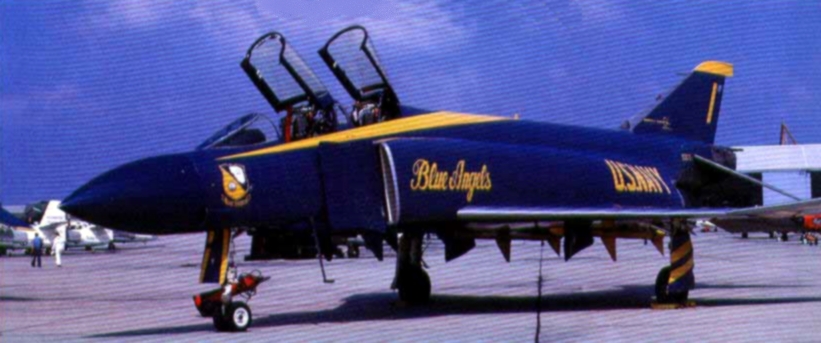
McDonnell Douglas F-4J Phantom II (1969–1974)


The largest and loudest jet the team has flown. Twin-engine and two-seat, though the Blues used it mainly as a demonstration platform in the diamond. It was the only type flown at the same time by both the Blue Angels and the Air Force Thunderbirds.
- Engines: 2 × General Electric J79-GE-10 afterburning turbojets (~11,870 lb dry / ~17,900 lb with afterburner each)
- Max speed: Mach 2.23 (~1,470–1,485 mph at altitude)
- Wingspan: 38 ft 4–5 in
- Length: ~58–63 ft
- Empty weight: ~30,000+ lb
McDonnell Douglas A-4F Skyhawk II (1974–1986)


Smaller, lighter, and highly maneuverable after the Phantom. The “Scooter” allowed tighter, more dynamic routines.
- Engine: 1 × Pratt & Whitney J52-P-8A or similar turbojet (~9,300 lb thrust; some team aircraft later used higher-thrust variants)
- Max speed: ~670–675 mph
- Wingspan: 27 ft 6 in
- Length: ~40 ft
- Empty weight: ~10,000–10,500 lb
McDonnell Douglas / Boeing F/A-18 Hornet A/B then C/D (1986–2020)


Longest-serving demonstration type, 34 seasons. Multi-role strike fighter with strong power-to-weight and high-alpha capability. A/B models first, then C/D. Two-seat B/D jets supported the No. 7 narrator role and other duties.
- Engines: 2 × General Electric F404 series afterburning turbofans (later enhanced versions ~17,000–18,000+ lb thrust class each with afterburner)
- Max speed: Mach 1.7–1.8
- Wingspan: ~40 ft 4–5 in
- Length: ~56 ft
- Empty weight: ~23,000 lb class
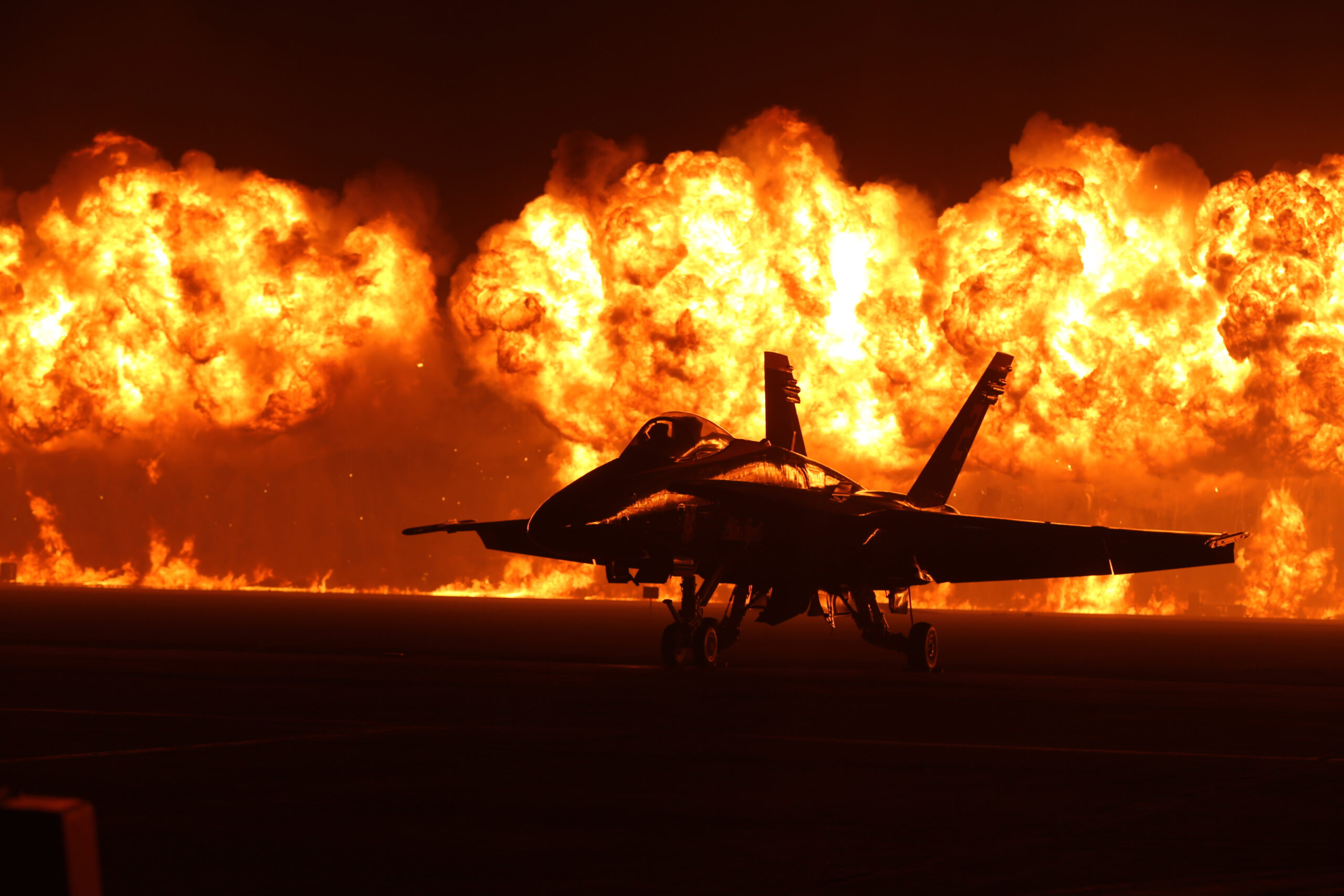
Boeing F/A-18E/F Super Hornet (2020–present)


Current aircraft. Larger, longer-ranged development of the legacy Hornet, with more internal fuel, stronger engines, and updated systems. The team transitioned in late 2020 and flew its first full Super Hornet season in 2021. About 11 jets are assigned to the squadron. Six fly the show.
- Engines: 2 × General Electric F414-GE-400 turbofans (~13,000 lb dry / 22,000 lb with afterburner each)
- Max speed: Mach 1.6–1.8
- Wingspan: ~44 ft 9 in
- Length: ~60 ft
- Empty weight: ~32,000 lb class
- Max takeoff weight: ~66,000 lb
Support and miscellaneous aircraft
Logistics aircraft have included the R4D Skytrain, R5D Skymaster, C-121 Super Constellation, and the Lockheed C-130 Hercules, later the C-130J Super Hercules, known as Fat Albert. Early shows also used an SNJ Texan (“Beetle Bomb”) to simulate an enemy fighter, plus brief use of types such as the T-33 and F7U Cutlass.
Each aircraft change tracked Navy frontline types of the era and added show capability: tighter formations, higher speeds, better climb, and more complex maneuvers. The diamond, introduced with the Bearcat, remains the centerpiece. In 2026 the team is marking both its own 80th year and America 250 while remaining combat-ready.