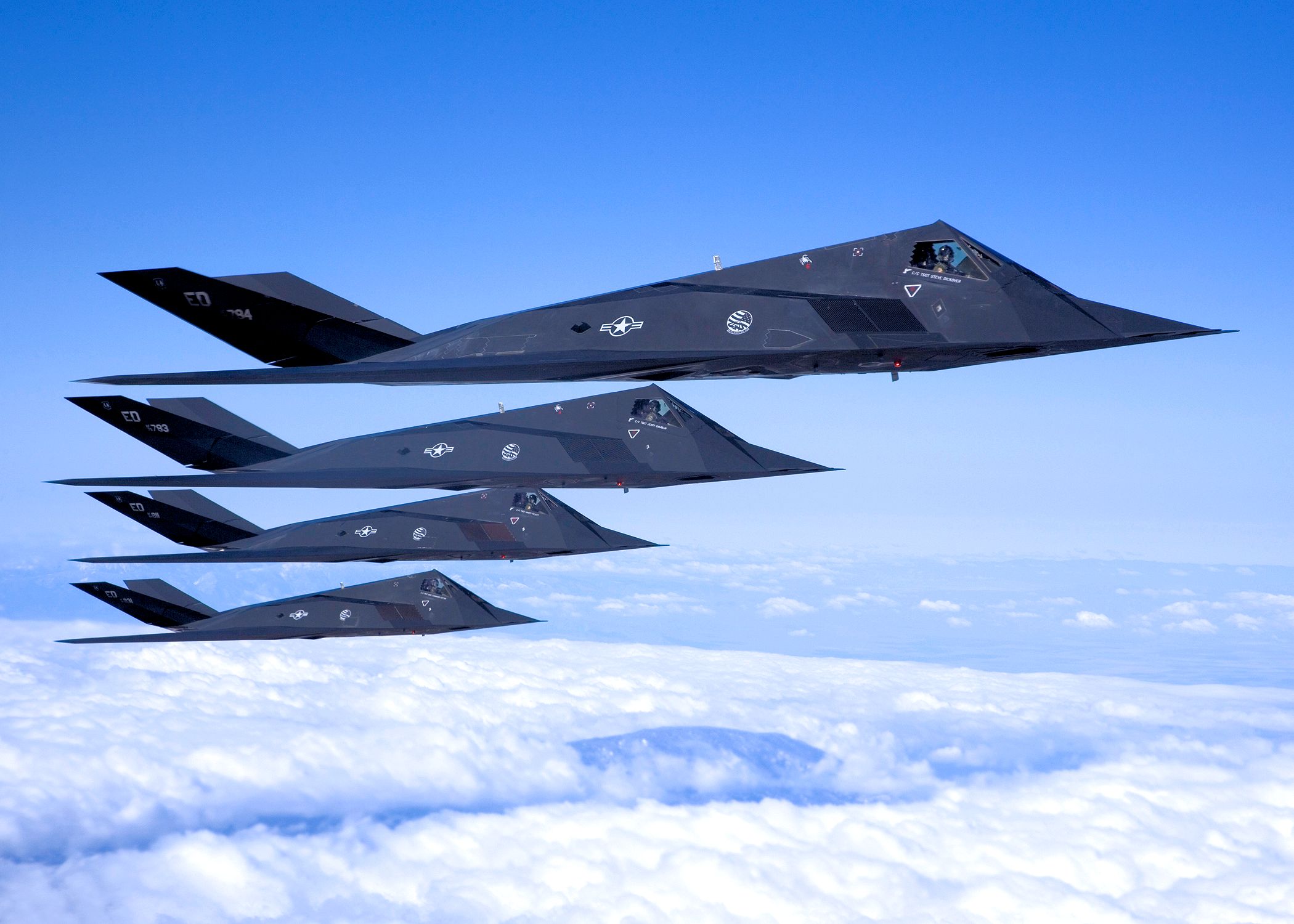
Here are some random, interesting facts about the Lockheed F-117 Nighthawk:
- It was never a true fighter. Despite the “F” designation (for fighter), it was a dedicated precision strike/attack aircraft with no guns or air-to-air missiles. The “F” label was reportedly chosen partly to attract top fighter pilots (who might not volunteer for a “B-117” bomber) and to help obscure its true role.
- Its radar cross-section was tiny—often described as about the size of a golf ball or small bird (roughly 0.001–0.01 m² in some estimates). By comparison, a conventional fighter like the F-15 had an RCS measured in tens of square meters. Faceted flat panels (not curves) scattered radar energy, and radar-absorbent materials (RAM) coated the airframe.
- Pilots nicknamed it the “Wobbly Goblin,” “Hopeless Diamond,” “Roach,” “Stinkbug,” or simply the “Black Jet.” The angular shape made it aerodynamically unstable and required constant computer (fly-by-wire) corrections to stay airborne. Early designs were jokingly called the “Hopeless Diamond” because the shape seemed unflyable.
- It was developed in extreme secrecy under programs like Have Blue (prototypes) and Senior Trend. The first flight of a production-related aircraft was in 1981; it reached initial operational capability in 1983 at the remote Tonopah Test Range in Nevada. For years it flew only at night on circuitous routes. The public first saw a (deliberately distorted) photo in 1988, with a proper unveiling later.
- In the 1991 Gulf War it punched far above its weight: roughly 2–2.5% of coalition combat sorties but responsible for a large share (reports often cite ~30–40%) of strategic targets hit. It flew about 1,300 sorties, dropped thousands of tons of bombs with high accuracy, and suffered no combat losses there. One of the opening bombs of the war (on a Baghdad telecommunications center) came from an F-117.
- Only one was ever lost in combat: F-117 serial 82-0806, shot down over Serbia on March 27, 1999, during the Kosovo campaign by an SA-3 (S-125) missile battery. Factors included predictable routing, bomb-bay doors opening (which briefly increased its signature), and clever use of older low-frequency radar to cue higher-frequency systems. The pilot ejected and was rescued.
- It relied on infrared sensors (FLIR and DLIR) plus a laser designator for targeting rather than onboard radar (to preserve stealth). Typical load was two laser-guided bombs (often 2,000 lb class) in internal bays. Opening those doors was one of the few times its signature spiked.
- Engines were non-afterburning GE F404 variants (similar to those in the F/A-18 but detuned for lower IR signature). Exhaust was expelled through narrow, flat, heat-absorbing slots to minimize infrared detectability. Top speed was high-subsonic (around Mach 0.9 / ~600+ mph).
- Officially retired in 2008 after ~25 years of service, but a number of airframes remain in storage or limited flight for testing (counter-stealth sensors, training, research). Sightings continue over Nevada and California ranges years later; some have even been photographed refueling with modern tankers or wearing experimental coatings.
- Fun oddities: Early secrecy was so tight that even the existence of the unit was hidden. A computer mission-planning tool that optimized routes against known radars was nicknamed “Elvira.” Bats reportedly collided with parked aircraft because their sonar didn’t “see” them well. About 59 production aircraft were built (plus a handful of prototypes/test airframes), with unit cost figures often cited in the $40–50 million range (program costs higher).
The F-117 proved that carefully applied shaping + materials + tactics could make a relatively slow, ungainly-looking jet extraordinarily effective against dense air defenses—and it still influences stealth thinking decades later.