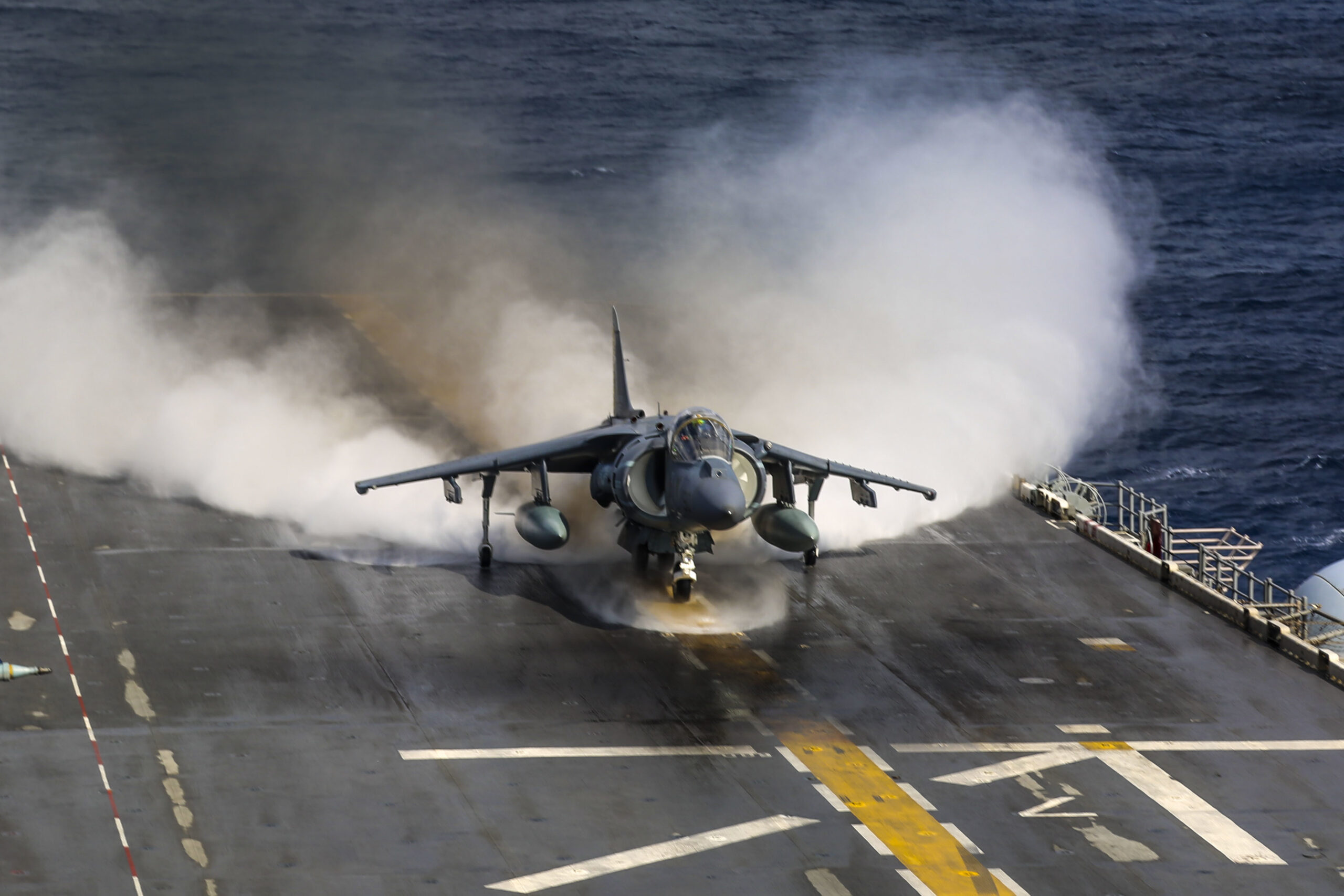
The AV-8B Harrier II was the second-generation V/STOL attack jet built around the Rolls-Royce Pegasus vectored-thrust engine. It gave the U.S. Marine Corps a fixed-wing strike aircraft that could operate from amphibious ships, expeditionary strips, and unprepared sites. After more than 40 years in Marine service, the type left the USMC inventory on 3 June 2026. Italy and Spain still fly it; Spain is now on track to become the last operator.


From P.1127 to Harrier II
The line begins with the Hawker P.1127 of 1960 and the first-generation Harrier / AV-8A. By the early 1970s the Marines wanted more payload, range, and lift than the AV-8A could deliver. A joint U.S.–U.K. “AV-16” project with a much larger Pegasus died on cost. The airframe was then redesigned around a new composite supercritical wing, larger inlets, lift-improvement devices under the fuselage, and a modern cockpit. Two YAV-8B prototypes, rebuilt from AV-8As, flew in 1978. The first true AV-8B flew on 5 November 1981. The first squadron stood up in January 1985.
The RAF’s Harrier GR.5/GR.7/GR.9 family is the U.K.-built counterpart, retired in 2010.
What changed from the first Harrier
The AV-8B’s wing has more area and span than the AV-8A, a supercritical section, and leading-edge root extensions. Carbon-fiber structure cut weight. Under-fuselage strakes and a retractable dam improved hover lift. The cockpit used HOTAS, a head-up display, and later night-vision-compatible lighting. Night Attack aircraft added a nose FLIR. Harrier II Plus aircraft added an APG-65 pulse-Doppler radar in a lengthened nose, plus AIM-120 AMRAAM capability.
Production of new airframes and remanufactured Plus jets ran through 2003. About 337 AV-8B-family aircraft were built for the United States, Italy, and Spain (excluding U.K. GR-series jets).
Accurate specifications (typical late AV-8B / AV-8B Plus)
Figures vary slightly by source and configuration. These are the values that appear most consistently in U.S. Navy/Marine data.
| Item | Figure |
|---|---|
| Crew | 1 |
| Length | 46 ft 4 in (14.12 m); Plus slightly longer in the nose |
| Wingspan | 30 ft 4 in (9.25 m) |
| Height | 11 ft 8 in (3.55 m) |
| Wing area | ~230–243 sq ft (21.4–22.6 m²) |
| Empty weight | ~13,970 lb (6,340 kg) day/NA; Plus ~14,865 lb (6,745 kg) |
| Max takeoff, short takeoff | 31,000 lb (14,100 kg) |
| Max takeoff, vertical | ~18,900–20,755 lb (8,600–9,415 kg) |
| Engine | 1 × Rolls-Royce F402-RR-408 Pegasus vectored-thrust turbofan |
| Thrust | ~23,500 lbf (105 kN) on the -408 |
| Max speed | ~585 kt / Mach 0.9 at sea level (~673 mph / 1,083 km/h) |
| Service ceiling | 50,000 ft (15,240 m) |
| Rate of climb | ~14,700 ft/min |
| Typical combat radius | Highly mission-dependent; often cited ~300 nmi. Heavy low-level loads can drop to ~90 nmi |
| Ferry range | ~1,800 nmi with external tanks |
| Gun | 1 × GAU-12/U 25 mm five-barrel cannon, 300 rounds (left pod; ammo in right pod) |
| Stores | 6 underwing + 1 centerline; about 9,200 lb (4,200 kg) max external load |
Weapons included Mk 80-series bombs, Paveway laser-guided bombs, JDAMs later in life, CBU cluster munitions, AGM-65 Maverick, AIM-9 Sidewinder, AIM-120 on Plus jets, Hydra/Zuni rockets, and Litening targeting pods. Four 300-gallon drop tanks were common for ferry and long-range profiles.
The Pegasus does not use an afterburner. Four swiveling nozzles vector thrust for hover, STOVL, and conventional flight. Reaction-control thrusters at the wingtips, nose, and tail handle hover attitude.
How the Marines used it
The mission set was close air support, armed reconnaissance, interdiction, and limited air defense, flown from LHDs/LHAs, expeditionary airfields, and austere sites. That basing flexibility was the point. In Desert Storm, Marine AV-8Bs flew 3,380 sorties and about 4,083 hours, with a high mission-capable rate and an average surge turnaround of 23 minutes. Five aircraft were lost. The type later flew over the Balkans, Afghanistan, Iraq, Libya, and other contingencies, often from the deck of an amphibious ship sitting close to the coast.
Night Attack jets arrived from 1989. Radar-equipped Plus jets entered service in 1993. A remanufacture program converted many early day-attack airframes to Plus standard; the last remanufactured USMC Plus was delivered in 2003.
Operators and the end of Marine service
Primary operators were the U.S. Marine Corps, the Italian Navy (from Giuseppe Garibaldi and later Cavour), and the Spanish Navy (EAV-8B / EAV-8B Plus from Príncipe de Asturias and Juan Carlos I). The two-seat TAV-8B served as the trainer.
The USMC retired the Harrier on 3 June 2026 after a sundown ceremony at MCAS Cherry Point, completing the shift to the F-35B. Italy is drawing down its remaining jets as F-35Bs arrive. Spain has declined the F-35B so far and plans to keep its Harriers flying into the early 2030s, taking retired U.S. airframes as spare-parts sources.
What the numbers actually mean
The AV-8B was never a fast interceptor. It was a short-field attack jet that could sit on a ship or a dirt strip and answer a CAS call in minutes. Payload and radius were always a trade against fuel and hover performance, especially in hot weather. That is why published combat radii swing so widely: a clean intercept profile and a 12-bomb, short-runway, one-hour-loiter profile are different airplanes in practice.
The F-35B inherits the STOVL idea with stealth, sensor fusion, and a much larger weapons and fuel envelope. The Harrier’s record is the decades it spent doing the job those extra sensors were meant to replace: putting bombs on a grid from a deck that did not need a catapult.