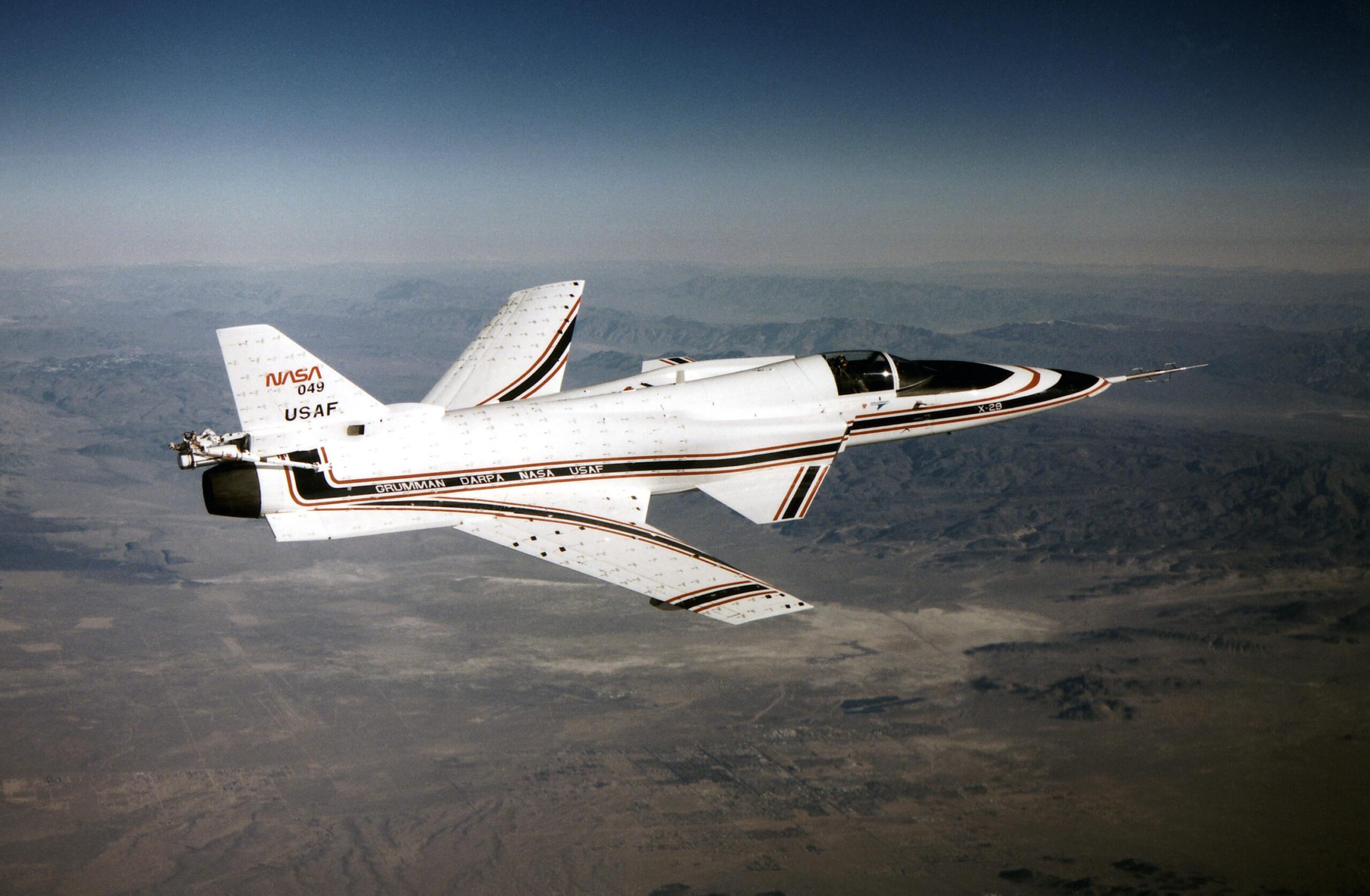


By the late 1970s composite materials finally solved a problem that had defeated designers for decades: how to build a forward-swept wing that would not twist itself apart under aerodynamic load. DARPA and the Air Force Flight Dynamics Laboratory sought a demonstrator to test whether the predicted advantages (better low-speed handling and resistance to the wingtip stalls that affect conventional swept-back wings) held up in flight. Grumman won the contract and built two X-29A aircraft. They reused the forward fuselage and nose landing gear from two F-5A Freedom Fighters, paired with F-16 control-surface actuators and main landing gear.
The first X-29 made its maiden flight from Edwards Air Force Base on 14 December 1984, flown by Grumman chief test pilot Chuck Sewell. With its center of gravity well aft of the aerodynamic center, the aircraft was inherently unstable. Stability came only from a computerized flight-control system that made roughly 40 corrections per second. The system used three redundant digital computers backed by three redundant analog computers; each channel “voted” so a faulty unit could be isolated. Total failure of the computers in flight would have torn the airframe apart from aeroelastic forces before the pilot could eject.
On 13 December 1985 an X-29 became the first forward-swept-wing aircraft to fly supersonic in level flight. The second aircraft, fitted with a spin-recovery parachute, handled high-angle-of-attack work and remained controllable to about 25 degrees, briefly reaching 67 degrees in a momentary pitch-up. Flight tests showed that the airframe’s extreme pitch instability did not produce the dramatic agility many had expected; the flight-control system had to limit pilot inputs to keep the aircraft from departing controlled flight.
The two aircraft completed more than 420 research flights between 1984 and 1992 before retirement. One is displayed at the National Museum of the U.S. Air Force in Dayton, Ohio; the other is at NASA’s Armstrong Flight Research Center at Edwards. The program was never intended to yield a combat aircraft, but it proved the forward-swept wing concept aerodynamically sound and contributed directly to later flight-control research.
Aircraft: Grumman X-29A
- Length: 48 ft 1 in (14.7 m) fuselage; 53 ft 11 in (16.4 m) including nose probe
- Wingspan: 27 ft 2.5 in (8.3 m)
- Height: 14 ft 3.5 in (4.4 m)
- Empty weight: 13,800 lb (6,260 kg)
- Max takeoff weight: 17,800 lb (8,074 kg)
- Payload: 4,000 lb (1,814 kg)
- Engine: 1 × General Electric F404-GE-400 afterburning turbofan, 16,000 lbf with afterburner
- Top speed: Mach 1.6 (1,100 mph / 1,771 km/h at 33,000 ft)
- Range: 400 mi (650 km)
- Service ceiling: 55,000 ft (16,800 m)
- Crew: 1