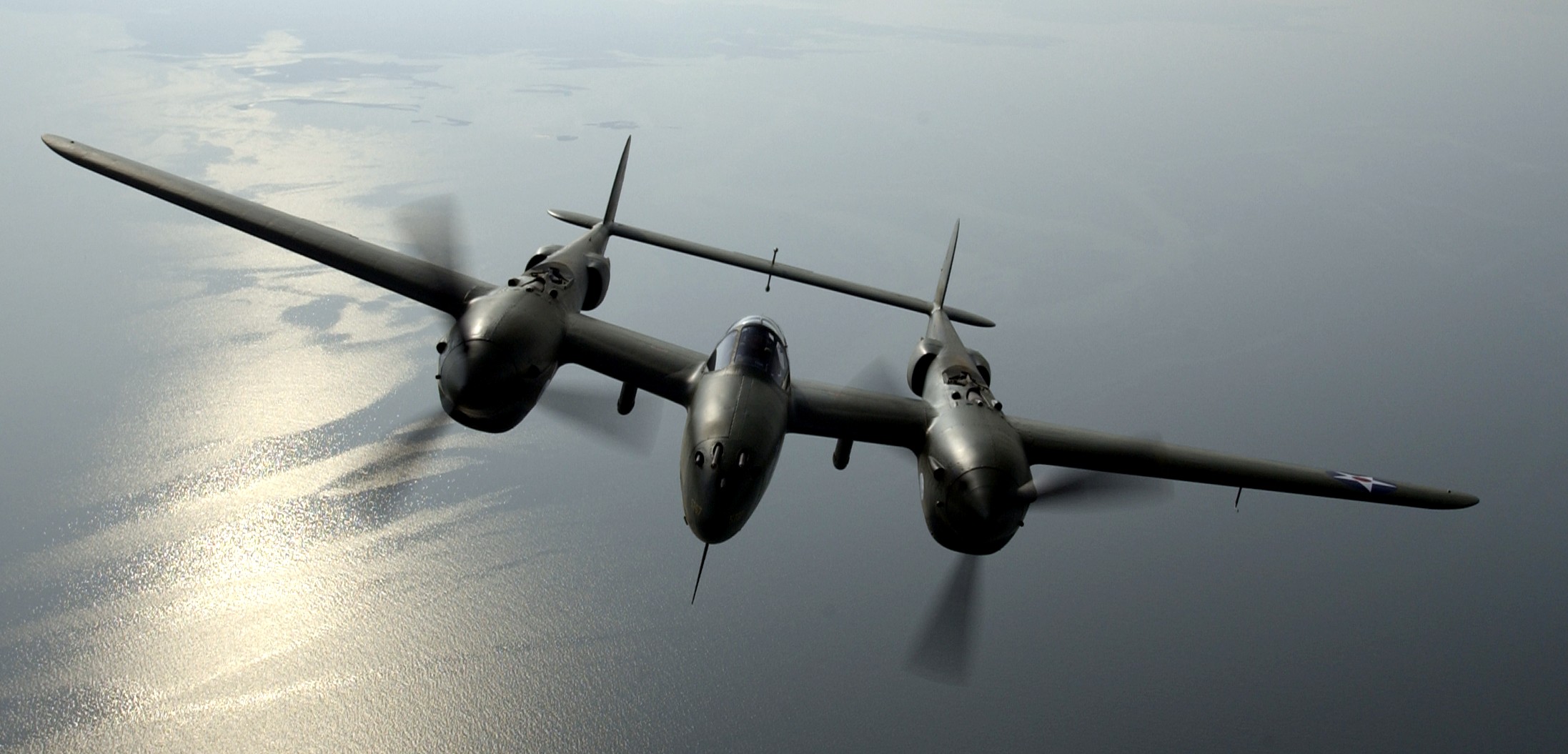


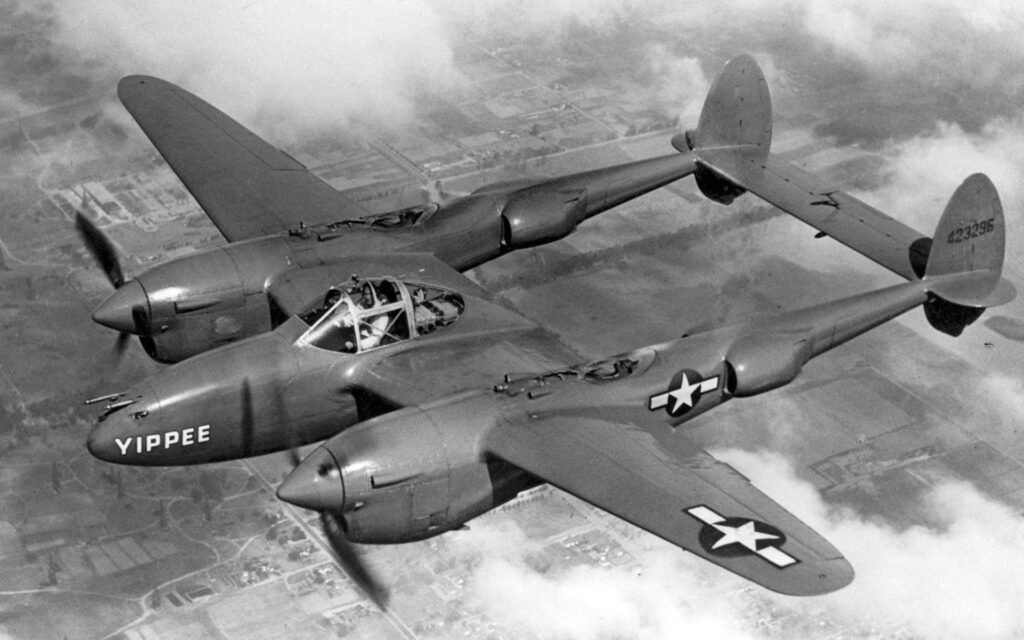


Lockheed designed the P-38 in response to a 1937 Army Air Corps specification calling for a fighter with speed, range, and climb rate that seemed impossible to achieve with a single engine. The design team, led by Hall Hibbard and a young engineer named Kelly Johnson, answered with something unlike anything else flying: a twin-boom, twin-engine fighter with a central nacelle for the pilot and nose-mounted guns. The XP-38 prototype first flew in January 1939, reaching 414 mph and proving the concept.
The Lightning became one of the most versatile American fighters of World War II, flying escort, interception, ground attack, and photo reconnaissance missions in every theater. Its concentrated nose armament, four .50 caliber machine guns and a 20mm cannon firing straight ahead rather than converging like wing-mounted guns, gave it excellent accuracy at range. Japanese pilots reportedly nicknamed it “two planes, one pilot,” while American pilots called it the “Fork-Tailed Devil.” America’s two top-scoring aces of the war, Richard Bong and Thomas McGuire, both flew P-38s.
Early models suffered from compressibility problems in high-speed dives, since the P-38 was among the first aircraft to approach the sound barrier’s effects, but Lockheed engineers worked through the issue with dive flaps and aerodynamic refinements on later models. Lockheed built over 10,000 Lightnings in total, with the P-38L, the final and most-produced version, accounting for nearly 4,000 of them.
Aircraft: Lockheed P-38 Lightning (P-38L, final production version)
- Length: 37 ft 10 in (11.5 m)
- Wingspan: 52 ft (15.8 m)
- Height: 9 ft 10 in (3.0 m)
- Empty weight: 12,780 lb (5,800 kg)
- Loaded weight: 17,500 lb (7,940 kg)
- Engines: two Allison V-1710-111/113 turbo-supercharged V-12s, 1,475 hp military rating each (1,600 hp war emergency power)
- Top speed: 414 mph (667 km/h)
- Range: 1,100 mi (1,770 km) combat, 2,600 mi (3,640 km) ferry
- Service ceiling: 44,000 ft (13,400 m)
- Armament: one 20mm Hispano cannon, four .50 caliber machine guns, plus rockets or up to 4,000 lb (1,814 kg) of bombs