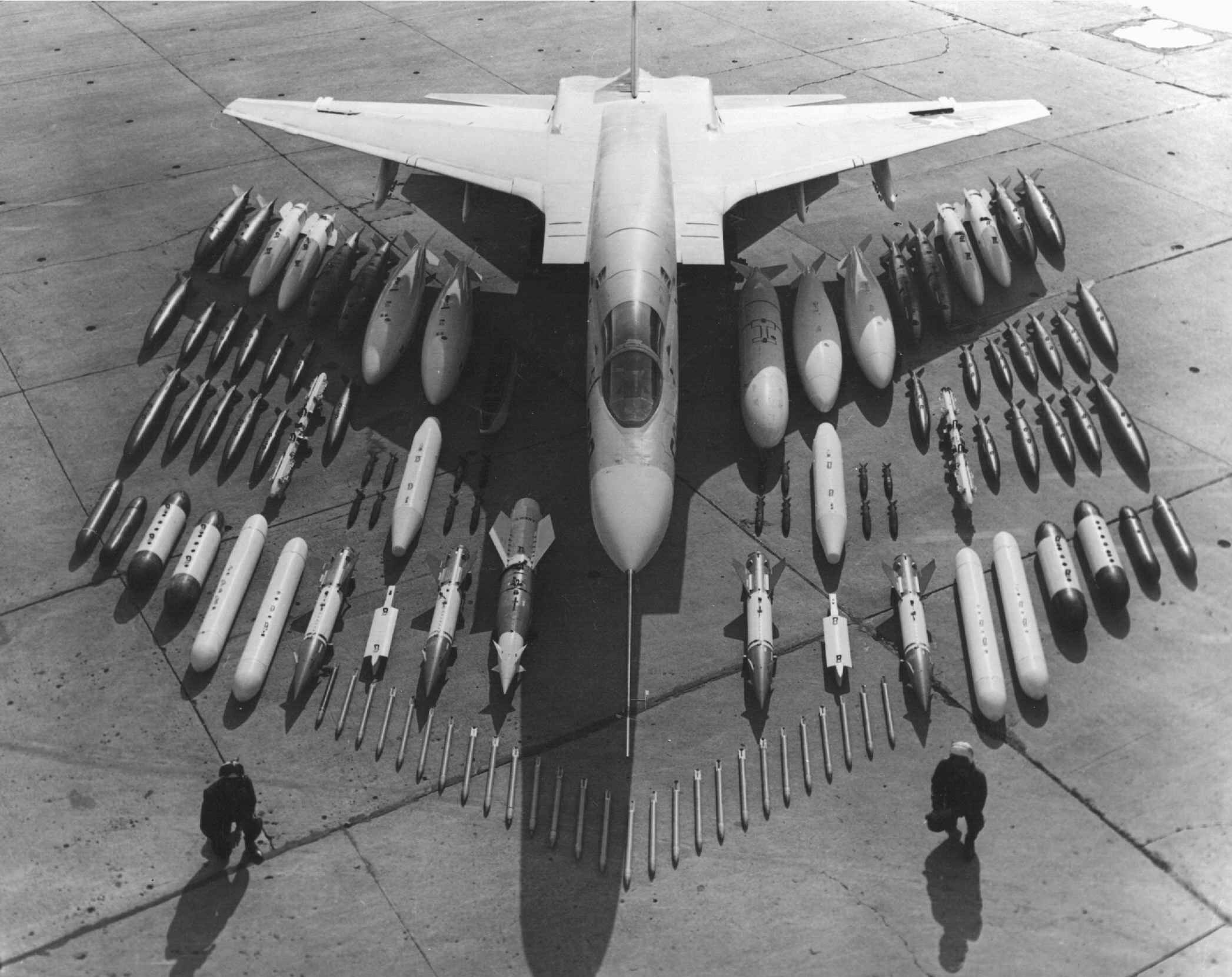
The North American A-5 Vigilante was the most advanced carrier aircraft of its generation. Built as a nuclear strike bomber, it spent almost its entire career as a high-speed reconnaissance jet. It never delivered a weapon in combat. It did fly some of the most dangerous photo missions of the Vietnam War.
North American Aviation’s Columbus, Ohio division began the design in 1954 as a private study. The Navy awarded a full development contract on 29 August 1956. The first prototype, then called YA3J-1, flew on 31 August 1958 with company test pilot Dick Wenzel at the controls. It went supersonic four days later. The type entered squadron service in June 1961 with Heavy Attack Squadron 3 (VAH-3) at NAS Sanford, Florida. In September 1962 the tri-service designation system renamed the A3J-1 the A-5A.
The original mission was carrier-based nuclear attack, a faster replacement for the Douglas A-3 Skywarrior. Polaris submarines soon took that mission. Production of the bomber stopped in 1963 after a short run. The airframe was then rebuilt as the RA-5C, a multi-sensor reconnaissance aircraft that first flew on 30 June 1962 and reached the fleet in 1964.
What made it advanced
The Vigilante packed several firsts for a production Navy aircraft: an early digital computer (Autonetics VERDAN), an AN/ASB-12 nav-attack system with a head-up display, fly-by-wire with mechanical backup, variable-geometry inlet ramps, and no ailerons. Roll control came from spoilers plus differential all-moving tailplanes. Wings, tail, and radome folded for carrier stowage. Materials included aluminum-lithium skins and titanium in high-heat areas.
The bomber’s signature feature was also its weakest. A linear bomb bay ran between the two engines. A nuclear weapon (typically Mk 27, B28, or B43) sat in a “stores train” with two disposable fuel tanks and was meant to be ejected rearward at high speed. The system was unreliable. Catapult shock sometimes spat the tanks onto the deck. No live nuclear weapon was ever carried in fleet service. On the RA-5C the tunnel became extra fuel.
On 13 December 1960 an A3J-1 set a world altitude record of 91,450.8 feet while carrying a 1,000-kilogram payload.
A-5A specifications
| Item | Figure |
|---|---|
| Crew | 2 (pilot and bombardier-navigator) |
| Length | 76 ft 6 in (23.32 m) |
| Wingspan | 53 ft 0 in (16.16 m); 42 ft folded |
| Height | 19 ft 5 in (5.91 m) |
| Wing area | 701 sq ft (65.1 m²) |
| Empty weight | 32,783 lb (14,870 kg) |
| Combat weight | 47,631 lb (21,605 kg) |
| Max takeoff | 63,085 lb (28,615 kg) |
| Engines | 2 × GE J79-GE-8 |
| Thrust | 10,900 lbf dry / 17,000 lbf afterburner each |
| Max speed | Mach 2 / 1,322 mph (2,128 km/h) at 40,000 ft |
| Speed at sea level | about 806 mph |
| Climb | 8,000 ft/min |
| Service ceiling | 52,100 ft |
| Combat range | 974 nmi (1,121 mi) |
| Ferry range | 1,571 nmi (1,808 mi) |
| Armament (design) | 1 nuclear store in linear bay; 2 wing pylons for B43, Mk 83, or Mk 84 |
Sources differ slightly on empty weight and max takeoff. The figures above follow the commonly cited Naval Air Systems Command set.
RA-5C specifications
The reconnaissance model added a long ventral “canoe” for cameras, AN/APD-7 side-looking radar, AN/AAS-21 infrared line scan, and ELINT gear. Wing area grew to about 754 sq ft. Empty weight rose to roughly 37,500 lb. Maximum takeoff weight is commonly listed near 79,588 lb. Later aircraft used J79-GE-10 engines at 17,860 lbf afterburner. Climb and ceiling dropped (about 6,600 ft/min and 49,000 ft), but high-speed cruise remained near Mach 2. Four wing stations were available. Weapons were retained on paper and never used in service.
Production
Most detailed production tallies put total new-build airframes at 156 from Columbus:
- 2 YA3J-1 prototypes
- 57 A-5A
- 18 A-5B / YA-5C airframes (most completed or converted as recon)
- 79 new-build RA-5C (43 early plus 36 attrition aircraft built 1968–1970)
About 43 A-5As and the A-5B batch were remanufactured to RA-5C standard. The last new aircraft left the factory in August 1970. Wikipedia’s higher “167” figure counts conversions differently. Use 156 for airframes built.
Vietnam
RA-5Cs first went to war from USS Ranger in August 1964. Eight of ten reconnaissance attack squadrons made 31 deployments through 1973. Typical work was pre-strike and especially post-strike photography over North Vietnam, often at medium altitude and high speed after the strike package had already alerted every gun and SAM site on the route.
That profile produced the highest loss rate of any Navy carrier type in the war. Common tallies: 18 combat losses (most to AAA, two or three to SA-2s, one to a MiG-21) plus additional operational losses. Combined Southeast Asia write-offs are often given as 26 or 27. On 28 December 1972, RA-5C BuNo 156633 (“Flint River 603”) from USS Enterprise became the only Vigilante shot down by a fighter and the last U.S. aircraft downed by a MiG in the war. Production was reopened in 1968 solely to replace combat attrition.
End of service
The last carrier deployment ended with RVAH-7 aboard USS Ranger in September 1979. The Navy retired the type on 20 November 1979. Cost, complexity, and a shrinking recon force ended the program. The mission later moved to F-14s with TARPS pods.
The Vigilante was too early for its own technology and too late for its original mission. What remains is a clean Mach 2 airframe, a set of hard numbers, and a combat record written entirely with cameras.